Kenechukwu Umelo
Technical Game Designer | Specialized in AI & Gameplay Systems
Game Jams
As a designer and programmer, I think highly of game jams. They’re a good way learn, collaborate, and stretch your skillset a bit. The final product is very rewarding at times, and they teach me so much. Each game below carries significance to my journey and lessons that made me a better developer.
Top 10 at #6 out of 439 Entries
Jam: Comfy Jam: Summer🏖️2026
Role: Game Programmer
Time of Development: 2 Weeks
Team Size: 5
Engine:

Game Overview:
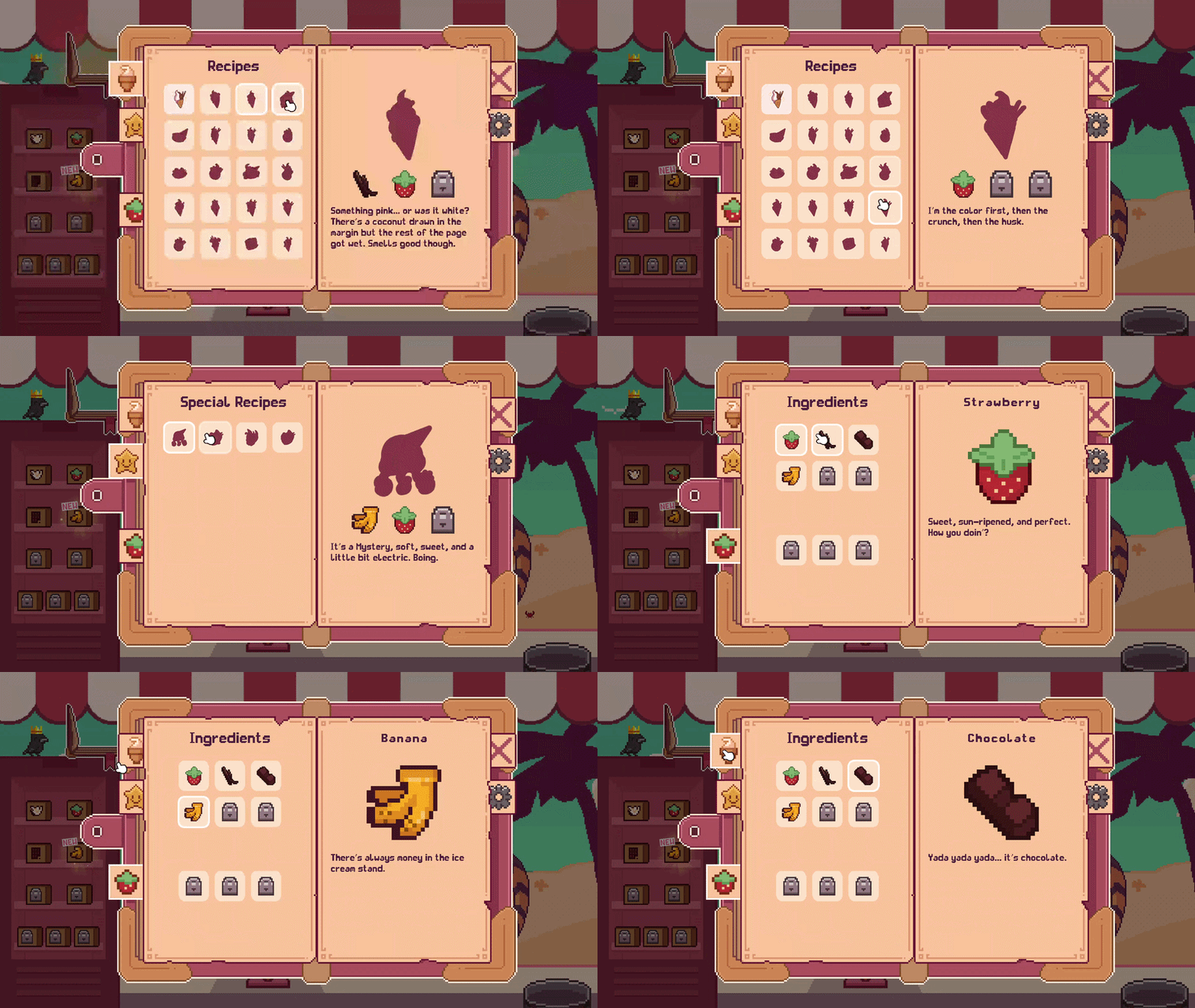
A recipe crafting game, where players mix various ingredients to create and unlock unique ice cream flavors, allowing for experimentation gameplay to lead towards incredible combinations.
The game features unlockables and a recipe book that players can view for progression.
Contributions


As a game programmer, I worked on the ice cream machine logic, crafting mechanics, draggable ingredients, recipe book system, custom UI logic, resource slots, and matching systems. I focused on ensuring the gameplay felt smooth and fun to experiment with for the players, enhancing the reason why the ingredients are mainly physics-driven.

Prototyping draggable ingredients and slot placements.

Core ice cream machine systems done and recipe book system and scriptable objects implemented.

Game polished with visual tweaks and bugs slashed.
Prototyping draggable ingredients and slot placements.
Recipe Book System
The recipe book system is the main driver behind unlockables, book UI, and crafting systems. I wanted to prevent others on the team from creating multiple references and variables to utilize for their own scripts or mechanics, so the answer was to script a global system that manages all ingredients and recipe conditions. This simple singleton reference helped shape many mechanics in the game and expanded to allow ingredients to be unlockable.

Quick Post-Mortem
Initially, I was hesitant about doing anything involving "crafting" mechanics due to my lack of knowledge on them. However, with the encouragement from my team and our design direction, which emphasized making crafting the core challenge mechanic, I was able to focus on creating something satisfying. This experience boosted my confidence and motivated me to expand my efforts beyond just crafting to include developing unlockables. I can confidently say that crafting mechanics are no longer a weakness for me, thanks to this game jam and my incredible team!
Top 50 at #49 out of 210 Entries
Jam: Comfy Jam: Spring 🌺2026
Role: Game Designer & Programmer (Blueprints)
Time of Development: 2 Weeks
Team Size: 3
Engine:

Game Overview:
A cozy adventure game where players traverse the environment to cut and collect grass with a scythe, then deposit it into nearby haystacks to increase collection scores.
Small secret: You can find cool hidden hats to wear along the journey.
Contributions
As the sole programmer, I developed the core player mechanics, the camera system, scythe abilities, collectible hats, and interaction systems using Blueprints to support an open-world exploration setting. I also implemented an on-screen UI/UX to visually showcase the player's progress in grass collection. The design goal was to create an authentic grass-cutting experience while rewarding players for exploring the world.


Environmental Design
During development, I handled designing rough 2 blockouts for an "exploratory" environment to test traversal, collisions, and orthographic camera limits.

To test camera view, collisions and general traversal time for the entire environment.

Used to test landscape tools in Unreal Engine

Iterated by fellow teammate (designer/3D artist)
To test camera view, collisions and general traversal time for the entire environment.
Post Jam
I felt a sense of pride as a programmer when I learned that the artist on my team landed his first job as a 3D artist thanks to this jam! It’s amazing to have been able to ensure that his work is showcased at a high quality, allowing his art to stand out!

Jam: Brackey's Game Jam 2023.2
Role: Game Programmer
Time of Development: 1 Week
Team Size: 6
Engine:
Game Overview:
Dungeon Divers is an endless, top-down 2.5D shooter in which players fight through layered encounters against multiple enemy archetypes to earn keys that unlock stat upgrades, enabling progression across runs.
The catch? The enemy's difficulty increases with every level.
Contributions
As one of the programmers, I developed the enemy AI archetypes, underlying spawn systems, and level generation. This was a close collaboration process as I constantly iterated the spawning logic to help the team test player mechanics, pick-up abilities, and ideas for enemies. Difficulty progression with enemies was the core design loop we aimed to deliver to keep the players from bottom-spawning levels.

Implemented generator that creates a new floor when the player destroys a level. Testing with the team, I ensure that the system can withstand potential button spamming of new floors.
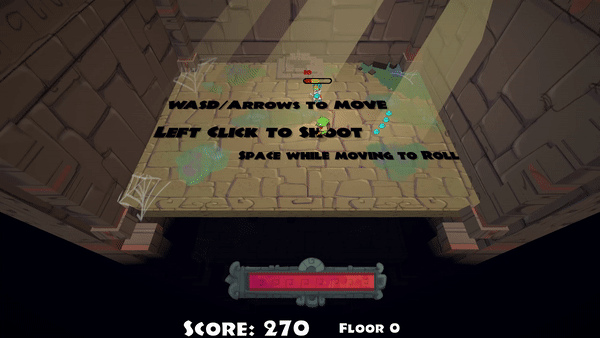
I quickly implemented a dynamic text-based tutorial on the first floor to guide players through the game. The intention was to bring players up to speed on how to play without requiring additional menus or panels.

Implemented a spawning system to handle enemy spawning, key placement, and property values for difficulty scaling. I opened up several float variables for designers and artists to tweak and test throughout the development cycle. For the enemy AI, I scripted all the movement behaviors and several types of weapon bullets for them to wield. The enemies were designed to offer players surprise mixed encounters at each level, preventing them from becoming stagnant and predictable.
Implemented generator that creates a new floor when the player destroys a level. Testing with the team, I ensure that the system can withstand potential button spamming of new floors.

Won "Best Illustration of Impact on the Built Environment"
_JPG.jpg)
Hackathon: 2019 Yale Climate Change Hackathon
Role: Game Programmer & Quality Assurance
Time of Development: 24 Hours
Team Size: 6
Engine:
Game Overview:
Eroglution is a virtual reality simulation that tackles climate change and CO2. The experience aims to be a fun illustration of how planting trees around the town reduces urban heat and surface temperatures.
Contributions
I learned how to use an HTC Vive headset and how to integrate the SteamVR plugin to enable the headset to work with Unity. I implemented movement controls and button-press inputs, which served as the foundation for other programmers to develop additional interactions in the game. After integrating SteamVR into the project, I took on the responsibility of playtesting the entire experience from start to finish. This involved repeatedly using the HTC Vive headset during the final six hours of development during the hackathon.
Player placing down trees around the enviornment
Reflection
This hackathon was the first time I worked with virtual reality. I easily adapted to the tools and software needed to get the project going from early on, which helped the team focus specifically on implementation. I then focused on ensuring a quality and polished experience, which led to a good presentation when the game was showcased to judges.
During the development, an unfortunate incident caused us to move our projects to Yale's provided desktops (hence why the project cannot be publicly seen). I learned that VR game development required a more VR-ready PC or laptop to handle the technical expense, so I acquired one afterward.

